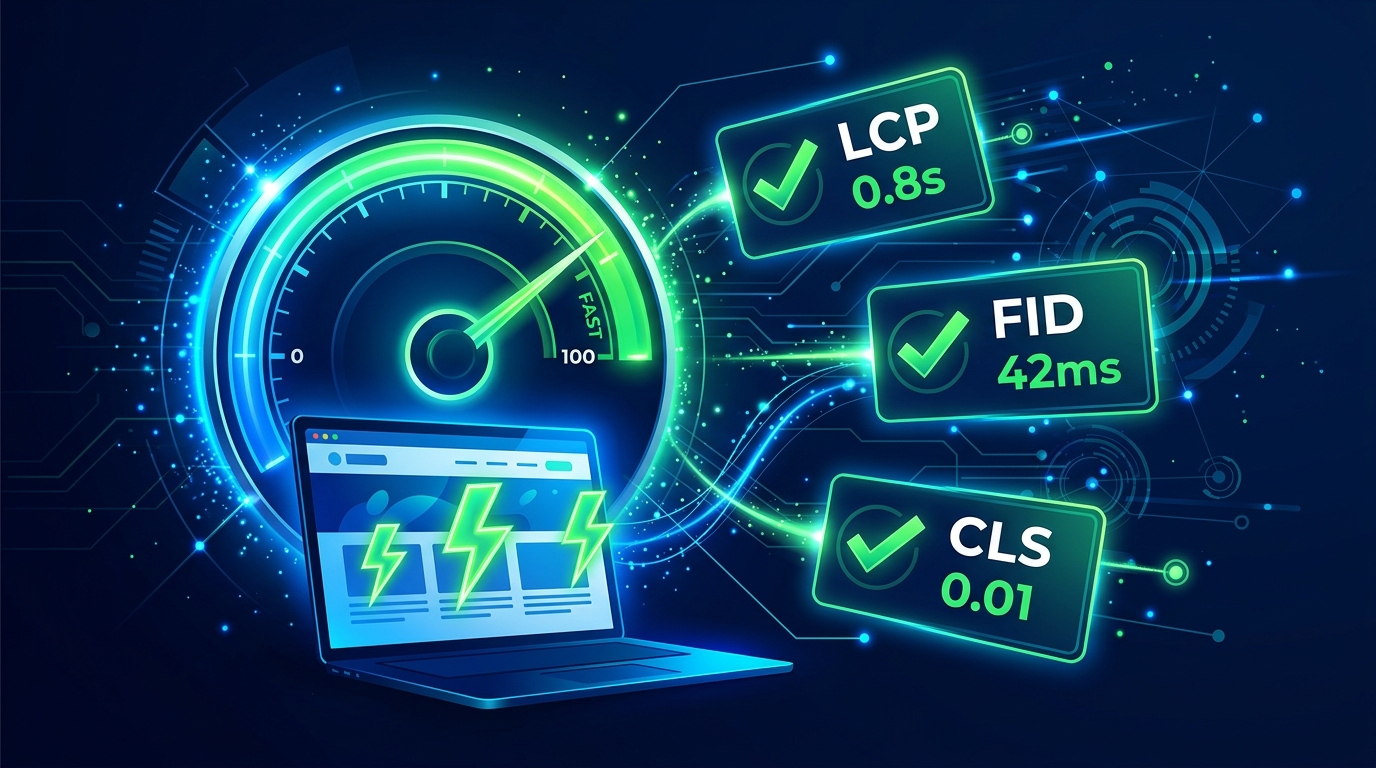
Google has made it clear that page experience is a key factor in how websites rank in search results. At the heart of Google’s page experience evaluation is a set of specific metrics known as Core Web Vitals.
The Three Core Web Vitals Metrics
Core Web Vitals measure real-world user experience across three essential dimensions:
- Largest Contentful Paint (LCP): Measures loading performance. Specifically, how quickly the largest block of content (such as a hero image or main heading) renders on screen. A good score is under 2.5 seconds.
- Interaction to Next Paint (INP): Measures page responsiveness. INP evaluates how quickly a page responds to clicks, taps, and keyboard interactions. A good score is 200 milliseconds or less.
- Cumulative Layout Shift (CLS): Measures visual stability. It checks whether elements jump around the screen unexpectedly while loading, which causes accidental clicks. A good score is 0.1 or lower.
Why Business Owners Should Care
A fast, stable website directly impacts your bottom line. Visitors who encounter slow or jumpy pages bounce immediately to competitors. Furthermore, Google gives preference in competitive search results to sites that deliver a clean page experience.
How to Optimize Your Core Web Vitals
- Compress and serve next-gen image formats (WebP, AVIF) with explicit dimension tags.
- Eliminate render-blocking JavaScript and unnecessary external third-party tracking scripts.
- Leverage modern web hosting with fast time-to-first-byte (TTFB) and effective caching.
Is technical performance hurting your search rankings?
Request a free technical SEO audit to test your website’s Core Web Vitals and site health.
Request Your Free Audit →